


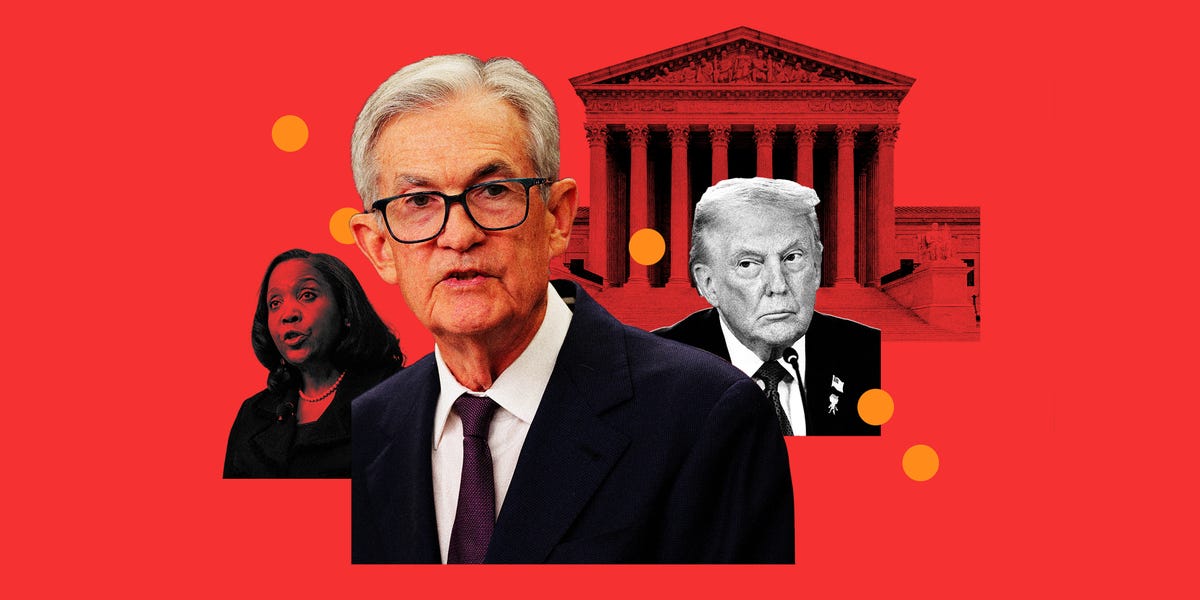
The U.S. Supreme Court is set to delve into a potentially groundbreaking case this Wednesday, examining the extent of presidential power over independent federal agencies. At the heart of the matter is the attempt by former President Donald Trump to remove Lisa Cook, a member of the Federal Reserve Board, raising critical questions about the Federal Reserve’s independence and the stability of the American financial system. The case isn’t simply about one individual; it’s about the future of how the central bank operates, free from undue political influence.
The Case of Lisa Cook: A Challenge to ‘For Cause’ Removal
Lisa Cook was appointed to the Federal Reserve by President Joe Biden, but before her term officially began, Trump sought her removal. The stated reason, a criminal referral alleging irregularities in past mortgage applications, is what Cook and her legal team are contesting. They argue this “cause” is merely a pretext, a fabricated justification masking a politically motivated effort to undermine the Fed.
This isn’t the first time the Trump administration has clashed with independent agency leaders. However, the Federal Reserve holds a unique position in the U.S. government, and the implications of this case are far-reaching. The core argument revolves around the legal standard for removing Fed governors – traditionally, it requires “cause,” a significant departure from the “at will” employment common in many other government positions.
Why the Federal Reserve’s Independence Matters
The Federal Reserve’s independence is a cornerstone of U.S. economic policy. Established to insulate monetary policy from short-term political pressures, the Fed is tasked with maintaining price stability and full employment. This means making difficult decisions about interest rates and the money supply, decisions that can be unpopular but are crucial for long-term economic health.
If a president could freely remove Fed governors for any reason, it would open the door to manipulating monetary policy for political gain. This could lead to inflationary pressures, economic instability, and a loss of confidence in the dollar. Economists and legal scholars widely agree that a politically controlled central bank is a dangerous proposition.
Recent Supreme Court Rulings and the Trend Towards Presidential Control
Over the past year, the Supreme Court has shown a willingness to expand presidential authority over independent agencies. In a 2020 case concerning the Consumer Financial Protection Bureau (CFPB), the court ruled that the president could fire the agency’s director at will. More recently, the court heard arguments in a case involving a Trump-era firing from the Federal Trade Commission (FTC), signaling a potential further erosion of protections for agency heads.
These rulings have raised concerns about a broader trend towards concentrating power in the executive branch. However, the justices have repeatedly acknowledged the special status of the Federal Reserve, hinting at a possible distinction in how they approach cases involving the central bank. The concept of agency independence is being actively redefined.
The Powell Investigation and its Impact on the Cook Case
Adding another layer of complexity to the situation is the ongoing Justice Department investigation into alleged political interference by Trump with Federal Reserve Chairman Jerome Powell. Powell himself has accused the Trump administration of attempting to pressure him with a “sham criminal probe.”
Constitutional law professor Josh Chafetz believes this investigation could influence the court’s decision in the Cook case. “John Roberts doesn’t want to throw the global economy into turmoil,” Chafetz stated, suggesting the Chief Justice will be mindful of the potential consequences of a ruling that further weakens the Fed’s independence. The timing of these events is undeniably significant.
Key Arguments and Potential Outcomes
Cook’s lawyers contend that the “for cause” standard is essential to protect the Fed from political interference. They argue that allowing a president to fire a governor based on unsubstantiated claims or past conduct would effectively turn the Fed into an extension of the executive branch.
The Trump administration, on the other hand, maintains that the president has broad authority to oversee the federal government and ensure that agency leaders are qualified and acting in the public interest. They argue that the “for cause” requirement is an unnecessary constraint on presidential power.
The Supreme Court’s decision could have several outcomes. They could uphold the traditional “for cause” standard, reaffirming the Fed’s independence. Alternatively, they could adopt a more lenient standard, potentially allowing presidents to remove Fed governors more easily. A third possibility is a nuanced ruling that attempts to strike a balance between presidential authority and agency independence, perhaps defining “cause” more narrowly. The future of monetary policy hangs in the balance.
What’s at Stake for the American Economy?
The stakes in this case are incredibly high. The Federal Reserve plays a vital role in managing the American economy, and its credibility depends on its perceived independence. If the court rules in favor of the Trump administration, it could embolden future presidents to exert greater control over the Fed, potentially leading to economic instability and a loss of investor confidence.
As Lev Menand, a professor of administrative law, points out, the Cook case could set a precedent for removing other Fed governors, including the chairman. This Wednesday’s oral arguments will provide crucial insights into the justices’ thinking and the likely direction of their decision, impacting not only the financial regulation landscape but the overall health of the U.S. economy for years to come.