


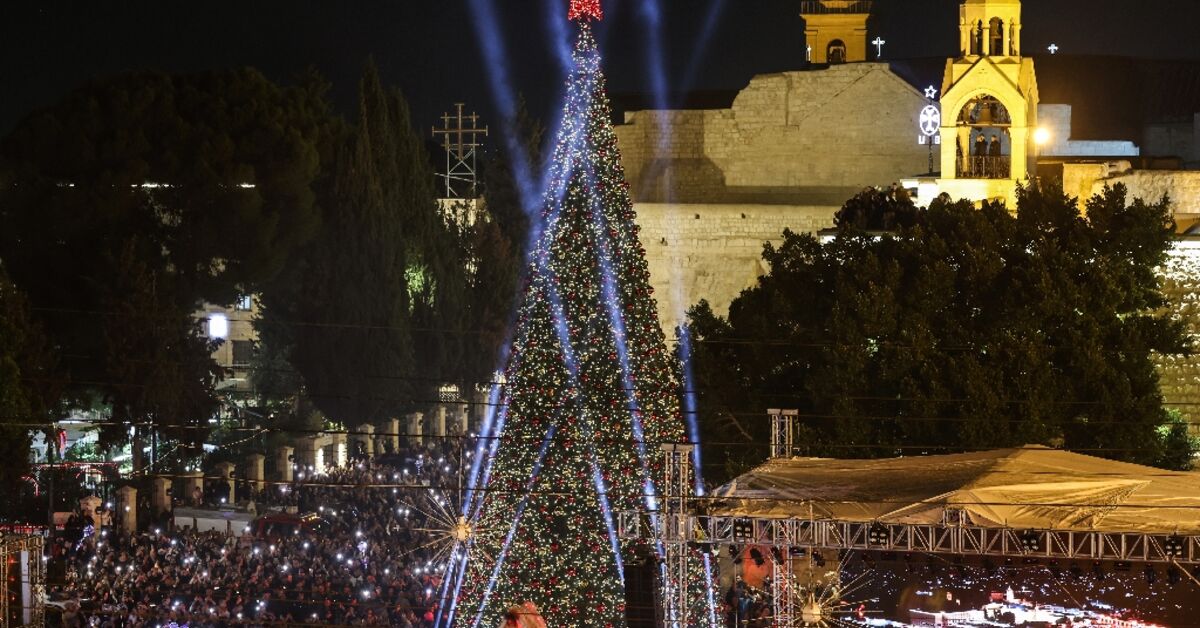
The city of Bethlehem, the traditional birthplace of Jesus Christ, experienced a poignant return to festive spirit on Saturday with the lighting of its Christmas tree. This marked the first such celebration in over two years, a beacon of hope emerging from the shadow of the ongoing conflict in Gaza. The event, deeply symbolic for Palestinians and observed by the international community, signifies a tentative step towards normalcy amidst continued hardship. The lighting of the Bethlehem Christmas tree wasn’t just a visual spectacle; it was a powerful statement of resilience and a yearning for peace.
A Symbol of Hope in Challenging Times
Covered in vibrant red and gold ornaments, the Christmas tree stood proudly in Manger Square, a mere distance from the historic Church of the Nativity. For residents and visitors alike, it quickly became a potent symbol of hope, a visual reminder of joy in a region often dominated by sorrow. The two-hour ceremony culminated in a breathtaking illumination, met with cheers and applause as the yellow lights twinkled and a brilliant red star shone against the backdrop of a clouded night sky, subtly illuminated by a nearly full moon.
The significance of this moment wasn’t lost on those present. Abeer Shtaya, a 27-year-old working at Al-Zaytoonah University of Science and Technology, travelled 100 kilometers with a group of students specifically to witness the event. “It’s like a symbol for resilience,” she explained, emphasizing the collective desire to celebrate and stand in solidarity with the people of Bethlehem.
The Return of Festivities and Visitors
The atmosphere in Manger Square was one of cautious optimism. After two years of scaled-back or non-existent celebrations due to the war, the return of the Christmas celebrations in Bethlehem drew thousands of attendees, a diverse crowd including both Christians and Muslims. Many travelled from across Palestinian territories and even from Israel, some venturing from much further afield, all eager to partake in the revived festive spirit.
Local businesses also felt a glimmer of hope. Mike Shahen, owner of a ceramic store on the square, noted the arrival of a handful of visitors making purchases. “It’s a message for the world that it’s calm,” he said, acknowledging the importance of projecting a sense of stability despite the surrounding turmoil. Families gathered, children pointed excitedly at the tree, and the sound of laughter, though tinged with a sense of fragility, filled the air.
A Tentative Recovery for Tourism
The past two years have been exceptionally difficult for Bethlehem, a city almost entirely reliant on tourism. While the city had begun to see a resurgence of visitors in 2022 following the COVID-19 pandemic, the outbreak of the war in Gaza brought that progress to a standstill. The current situation represents a tentative return to some semblance of normalcy, but the road to full recovery remains long and uncertain.
Christian pilgrims, particularly from Asia, South America, and Eastern Europe, have begun to slowly return in recent months. Fabien Safar, director of Terra Dei, a pilgrimage organizer, reported receiving some bookings for Christmas 2024 and even for 2026. However, he tempered expectations, stating that a genuine recovery is likely not to occur until 2027, and even that is contingent on the evolving political landscape. “This obviously depends on how the situation evolves in Gaza and Lebanon,” Safar cautioned.
Lingering Fears and Travel Restrictions
Despite the ceasefire in November 2024, ongoing Israeli strikes in Lebanon continue to fuel anxieties among potential visitors. Safar highlighted that pilgrims “remain afraid because there’s no official end to the war” in Gaza, and the situation in Lebanon adds another layer of concern. The lack of a definitive resolution to the conflicts casts a long shadow over the region, impacting travel decisions.
The difficulties extend beyond the immediate threat of conflict. Travel within the West Bank has become increasingly challenging since the October 2023 attacks, with lengthy delays at Israeli military checkpoints. Liyu Lu, a visitor from northern Israel, recounted waking up at 6 am to catch a bus, arriving in Bethlehem at 12:30 pm after a journey complicated by these checkpoints. She described the event as “quite emotional” after two years of “nothing but war and death.” The impact of these restrictions on the tourism industry in Palestine is substantial.
The Weight of Recent History
The contrast between the current situation and the recent past is stark. As Shahen pointed out, “Covid was bad but nothing like the last two years.” The pandemic, while devastating to tourism globally, did not carry the same weight of fear and political instability as the ongoing conflict. The surge in violence in the West Bank, which has continued even with the fragile truce, further exacerbates the challenges faced by Bethlehem and its residents. The lighting of the Bethlehem Christmas tree is therefore not simply a celebration, but a powerful act of defiance and a testament to the enduring spirit of a community determined to find joy amidst adversity.
The hope is that this small spark of festivity will grow, attracting more visitors and contributing to the economic and emotional recovery of Bethlehem. However, lasting peace and stability remain the essential ingredients for a truly sustainable future for this historic city and the wider region. Share this article to spread awareness of the situation and the resilience of the people of Bethlehem.